Skip to content

Estimated Reading Time: 9 minutes
Key Takeaways
-
Event venue damage insurance protects hosts from costly repair or replacement bills when something goes wrong at a rented space
-
Most standard homeowner’s or renter’s policies do NOT automatically extend to rented event venues. A separate policy is almost always required.
-
Coverage limits, deductibles, and exclusions vary widely between providers. Comparing policies carefully matters.
-
Venues often require proof of coverage before they’ll hand over the keys. Getting insured early avoids last-minute scrambles.
-
Both one-time event policies and broader special event coverage exist. Knowing which fits your situation saves money.
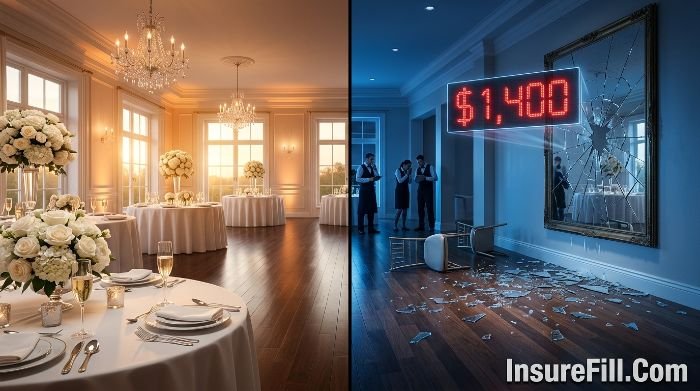
You booked the venue months ago. The deposit cleared. The catering is confirmed. And then, somewhere between the photo booth and the after-dinner dancing, a guest backs into a vintage mirror mounted near the bar.
It shatters.
The venue manager is polite about it. But the invoice that arrives three days later is anything but. $1,400 for the mirror. $300 for a damaged section of the hardwood floor underneath.
That’s the moment most hosts realize they had no idea event venue damage insurance was even a thing.
It’s one of those coverage gaps that catches people completely off guard. You think about the food. The flowers. The guest list. But the financial exposure sitting quietly underneath a rental agreement? That rarely makes the planning checklist.
This guide covers everything you need to know. What venue damage insurance actually covers. Where it falls short. How much it typically costs. And how to get it right the first time.
What Event Venue Damage Insurance Actually Covers
The core purpose of this coverage is straightforward. It protects the event host from out-of-pocket costs when property at a rented venue gets damaged during their event.
But the specifics matter a lot.
Damage to rented premises coverage typically includes:
- Accidental damage to the building structure itself (walls, floors, ceilings, built-in fixtures)
- Damage to venue-owned furnishings and décor
- Damage caused by guests, vendors, or even the host during setup and breakdown
- In some cases, equipment damage if the venue provides audio-visual or catering gear
What it generally does NOT cover is just as important.
Intentional damage gets excluded universally. Pre-existing conditions in the space get excluded. Normal wear and tear gets excluded. Damage that occurs outside your rental window gets excluded.
Read your policy’s definition of “event period” carefully. Some policies only cover the hours of the event itself. Not setup time. Not teardown time.
Many venue rental contracts include damage clauses that hold the host personally liable for repairs up to a specific dollar amount. That number can range from a few hundred dollars to tens of thousands depending on the space.
Signing that contract without coverage in place means you’re self-insuring that risk entirely.
How This Differs from Liability Coverage (And Why You Likely Need Both)
A lot of hosts confuse property damage coverage with special event liability insurance. They’re genuinely different products.
Liability insurance covers bodily injury or property damage claims made by third parties against you. So if a guest slips on a wet dance floor and sues, that’s a liability claim. If your DJ’s equipment cable trips a server who then drops a tray into a wall-mounted display case, depending on how the claim unfolds, it could touch both categories.
Venue damage insurance specifically protects against the venue’s property getting damaged. You pay the venue for what got broken. The coverage reimburses you rather than leaving you holding the bill.
Many special event policies bundle both into one package. Others sell them separately.
When you’re shopping, ask explicitly: does this policy include damage to rented premises, or is that an add-on?
Don’t assume.

The Insurance Information Institute notes that bundled special event policies often provide the most cost-effective protection for one-time gatherings. According to recent industry data from 2026, approximately 68% of venue-related damage claims fall between $500 and $3,500 per incident. That’s a significant out-of-pocket expense for most hosts.
Hosts often underestimate the financial exposure embedded in standard venue contracts. Damage waiver clauses have become increasingly detailed, and the cost of venue repairs, particularly in historic or upscale spaces, can easily reach five figures from a single incident.
Types of Events That Typically Require This Coverage
Not every venue will require proof of damage insurance. But more are asking for it every year.
As of 2026, a growing number of commercial event spaces require event hosts to provide a certificate of insurance before access is granted. This is particularly true in urban markets and higher-end venues.
Events where this comes up most often:
- Wedding receptions held at rented banquet halls, historic estates, or outdoor venues with permanent structures
- Corporate events and team outings at conference centers or unique experience venues
- Birthday parties, milestone celebrations, and reunions at restaurant private dining rooms
- Charity galas and fundraisers at art galleries, museums, or hotel ballrooms
- Private parties at loft spaces, rooftop venues, or vacation rental properties listed for events
If you’re hosting a backyard barbecue at your own home, this specific coverage doesn’t apply in the same way. You’d look at homeowner’s liability instead.
But the moment you rent a space, you’ve taken on contractual responsibility for that property during your event window.
Planning a corporate gathering with team activities? The coverage dynamics shift slightly when company assets and employee safety intersect. Check out this breakdown of corporate team outing liability insurance for the specific exposures companies face.
What Venue Contracts Actually Say (And Why It Matters)
Before you even look at a policy, pull out your venue rental agreement. Read it word for word.
This is where most hosts discover how much financial exposure they’ve already agreed to in writing.

Common clauses to watch for:
Security deposit provisions. Most venues hold a deposit (sometimes $500 to $5,000) and reserve the right to keep it for any damage. Plus bill you for costs above that amount.
Indemnification clauses. Language that says you’ll hold the venue harmless for losses arising from your event. This includes damage caused by your guests or vendors.
Vendor requirements. Some contracts require that your hired vendors (photographers, bands, caterers) also carry their own liability policies.
Time frame definitions. What hours does your rental technically cover? Damage during setup the morning before often falls outside the stated event hours.
Getting familiar with these clauses before purchasing insurance lets you match your coverage to the actual contractual risk you’ve accepted.
A licensed insurance agent can help you read the policy against the contract to confirm alignment.
For guidance on understanding your rights as a consumer before signing a rental contract, the Consumer Financial Protection Bureau offers resources on contract review and financial obligations. The National Association of Insurance Commissioners (NAIC) also provides state-by-state tools for verifying coverage options and filing complaints if a claim is disputed.
Coverage Limits and Cost: What to Realistically Expect
Premiums for event venue damage insurance vary based on a handful of factors. No two events are identical. So there’s no single number that applies across the board.
Understanding the variables gives you a solid starting point.
Factors that influence cost:
Event Insurance Premium Factors
| Factor | How It Affects Premium |
|---|---|
| Event size (guest count) | More guests typically means higher risk and higher premium |
| Venue type | Historic or high-value venues carry higher repair costs |
| Event duration | Multi-day events cost more to cover than single-day gatherings |
| Requested coverage limit | Higher limits mean higher premiums |
| Location (state) | State regulations and local repair costs factor in |
| Alcohol service | Events serving alcohol often carry higher premiums or require additional coverage |
| Type of event | Corporate vs. private vs. ticketed events are rated differently |
Event size (guest count)
More guests typically means higher risk and higher premium
Venue type
Historic or high-value venues carry higher repair costs
Event duration
Multi-day events cost more to cover than single-day gatherings
Requested coverage limit
Higher limits mean higher premiums
Location (state)
State regulations and local repair costs factor in
Alcohol service
Events serving alcohol often carry higher premiums or require additional coverage
Type of event
Corporate vs. private vs. ticketed events are rated differently
For a single-day event at a standard venue with a $25,000 to $50,000 damage limit, most hosts pay somewhere between $75 and $300 for damage coverage alone. Though this can swing significantly based on the factors above.
Adding liability coverage to a bundled policy typically brings the total to somewhere in the $150 to $600 range for a one-time event.
These are general ranges only. Your actual premium will depend on your specific event profile. You should get quotes from multiple providers before deciding.
Never treat a range estimate as a guaranteed figure.
If you’re also worried about the event being called off entirely due to weather or unforeseen circumstances, wedding cancellation insurance covers a different but equally important financial risk.
Event Insurance Cost Estimator
*Estimates based on 2026 industry averages. Actual costs may vary.
How to Purchase Event Venue Damage Insurance

The process is simpler than most people expect.
Step 1: Review your venue contract first. Understand what coverage limits the venue requires. Many contracts specify minimum amounts.
Step 2: Check your existing policies. Your homeowner’s or renter’s policy may have a personal liability component. But it almost never covers property damage to a rented venue. Call your insurer and ask directly before assuming anything.
Step 3: Compare specialized special event insurers. Several companies offer standalone one-day event policies that can be purchased online. The application process typically takes under 20 minutes.
Step 4: Confirm the certificate process. Once you’ve purchased a policy, the insurer will provide a certificate of insurance. Most venues require this at least 7 to 14 days before the event.
Step 5: Review the policy’s event period definition. Confirm that your setup and breakdown time falls within the covered window. If not, ask about extending it. Some providers accommodate this.
Working with a licensed independent insurance agent gives you access to multiple carriers. Someone who can compare options objectively.
This is particularly useful if your event has unusual features. Outdoor space. Alcohol service. Large guest counts. Or vendors bringing in expensive equipment.
Common Mistakes Hosts Make (And How to Avoid Them)
Think about it this way. Most claims don’t come from dramatic disasters. They come from ordinary moments that nobody planned for.
A few mistakes that tend to show up repeatedly:
Assuming the venue’s own insurance covers you. It doesn’t. The venue’s property policy covers the venue owner’s interests. You, as the renting party, are typically not an insured under that policy. You are the party they’d make a claim against.
Buying coverage too late. Purchasing a policy the day before the event leaves no time to resolve any issues with the certificate. Most venues want documentation well in advance.
Ignoring alcohol-related exclusions. If your event includes an open bar and you haven’t purchased a policy that includes or explicitly addresses alcohol service, you may have a gap. Alcohol-related incidents account for a disproportionate share of event damage and liability claims.
Forgetting vendor-caused damage. If a catering company’s staff damages a wall-mounted wine rack during service, who’s responsible? Your policy, the caterer’s policy, or both? Understanding how your coverage interacts with vendor liability matters more than most hosts realize.
For private gatherings specifically, private party liability insurance walks through how host responsibility works in social event settings.
State-by-State Considerations
Insurance is regulated at the state level in the United States. The carriers available to you, the minimum coverage standards, and how disputes are handled can vary depending on where your event is held.
Some states have more consumer-friendly regulations around event policy disclosures. Others have specific requirements around how venue contracts can assign liability.
The NAIC’s state insurance commissioner directory lets you find your state regulator directly if you have questions about policy requirements. Or if you want to verify that a carrier is licensed to operate in your state.
If your event crosses state lines, the policy should be written to cover the event’s physical location. Not necessarily where you live.
Say you’re hosting a destination event at a venue in a different state than your home state. Coverage needs to align with that venue’s jurisdiction.
What to Do If You Need to File a Claim
Nobody goes into an event expecting to file a claim.
But if something does happen, how you handle the first 24 to 48 hours significantly affects how smoothly the process goes.
Document everything immediately. Take photos and video of any damage before anything is moved or cleaned up. Get a timestamp on every image if your phone allows it.
Notify the venue in writing. Don’t just have a verbal conversation. Send a follow-up email that summarizes what happened, when, and who witnessed it.
Contact your insurer promptly. Most policies require you to report a claim within a specific time window. Often within 24 to 72 hours of the incident. Missing this window can complicate your claim.
Get the venue’s repair estimates in writing. Ask for itemized estimates. Not just a total. This allows your insurer to review what’s being billed and flag anything that seems inflated or unrelated to the actual damage.
Keep records of all communications. Every email. Every invoice. Every insurance communication should be saved in one place throughout the process.
For charity events where donated items or auction goods might be involved, charity event insurance protection covers some unique considerations around donated property and volunteer-driven activities.
Understanding Policy Exclusions That Catch Hosts Off Guard
Most policies look similar on the surface. But the exclusions section is where you’ll find the real differences.
Common exclusions that surprise hosts:
Flood and earthquake damage. Standard policies typically exclude these. If your venue is in a flood zone or seismically active area, you may need a rider.
Intentional acts. Damage caused deliberately by anyone gets excluded universally. This includes vandalism by uninvited guests who crash your event.
Pre-existing damage. If that crack in the wall was already there before your event started, your policy won’t cover it. This is why a pre-event walkthrough with photos matters.
Damage outside the event period. If you rent from 6 PM to midnight but a vendor arrives at 4 PM to set up and damages something, that may not be covered unless your policy specifically includes load-in time.
Read the exclusions section of any policy before purchasing. If something listed there concerns you, ask if a rider or endorsement can add that coverage back in.
How Venue Type Affects Your Coverage Needs
A hotel ballroom carries different risks than a historic mansion. An outdoor pavilion carries different risks than a rooftop lounge.
Your coverage should reflect the venue’s specific characteristics.
Historic venues. These often require higher coverage limits because replacement costs for period-specific architectural details can be astronomical. A damaged original marble mantelpiece can’t be replaced at Home Depot.

Outdoor venues with permanent structures. Tents, gazebos, and pavilions can sustain wind or weather damage during your event. Some policies cover this. Others don’t.
Multi-use commercial spaces. Loft spaces and warehouses converted for events may have unique fixture exposures. Industrial lighting. Exposed brick. Original wood floors. Damage to these can be expensive.
Residential properties rented for events. If you’re renting someone’s private estate or large home, coverage needs may differ from commercial venues. Some standard event policies exclude residential properties entirely.
Ask your insurer directly: does this policy cover the specific venue type I’m renting?
Important Venue Insurance Disclaimer
The information in this article is provided for general educational purposes related to event venue damage insurance and is not intended as personalized legal, financial, or insurance advice. Coverage terms, exclusions, and premium ranges vary significantly between insurers and across U.S. states. Always review your specific policy documents carefully and consult a licensed insurance professional before making coverage decisions for your event. Premium estimates mentioned reflect 2026 industry averages and are not guarantees of actual cost.
FAQs
A: In most cases, no. Standard homeowner’s policies include personal liability coverage, but this typically applies to incidents at your own residence. It doesn’t extend to contractual liability you’ve accepted by renting a venue. Some policies have limited third-party property coverage. But relying on this without confirming it explicitly with your insurer is a significant risk. A standalone event venue damage policy is almost always the cleaner solution.
A: Start by reading your rental contract. Many venues specify a minimum coverage amount. If the contract doesn’t specify, a good general guideline is to purchase at least enough to cover the full replacement value of the venue’s most expensive fixtures or furnishings. For upscale venues, that can mean $50,000 or more. For simpler spaces, $25,000 may be sufficient. An insurance agent can help you assess the right limit for your specific venue.
A: Some providers do offer same-day coverage. But this is the exception rather than the rule. Many venues require a certificate of insurance days or weeks in advance. Purchasing coverage at the last minute also leaves no time to resolve any policy questions or adjustments before your event. Getting insured at least two to four weeks out is strongly recommended.
A: This depends on how your specific policy is written. Some policies cover damage caused by vendors working at your event. Others consider vendor-caused damage the vendor’s responsibility under their own liability policy. You should confirm this directly with your insurer when purchasing. Requiring your vendors to carry their own liability insurance is a good practice regardless.
A: No. This is one of the most frequent misunderstandings. Liability insurance covers claims made against you by injured guests or third parties. Venue damage coverage specifically reimburses you for physical damage done to the rented property. They address completely different risks. Many events benefit from having both. Many providers offer bundled policies that include both for a single premium.
A: Alcohol service increases your risk profile significantly. Some policies exclude or limit coverage for incidents connected to alcohol. Others include it or offer it as a specific add-on. If your event includes an open bar, cash bar, or any form of alcohol service, confirm explicitly with your insurer how alcohol-related damage is handled in your policy. Overlooking this can leave you with an unexpected coverage gap.
A: This happens more often than you’d think. First, request a detailed itemized estimate from the venue. Not just a lump sum. Then share that with your insurance company. Most insurers have claims adjusters who evaluate whether repair costs are reasonable. If you believe the venue is claiming for pre-existing damage or exaggerating costs, document everything and communicate your concerns to your insurer in writing. In some cases, your policy may include dispute resolution provisions.