Skip to content


A rare 1909-S VDB Lincoln cent in MS-65 condition sells for thousands. An 1804 Silver Dollar — one of only 15 known — commands millions at auction. These aren’t hypothetical values. They’re documented sales that happen every year in the numismatic market, and they represent exactly the kind of asset that standard homeowners insurance treats as though it were a drawer full of loose change.
Collector coin insurance is the coverage built around how numismatic assets actually work — graded certifications, volatile market values, transit to shows, and the fundamental difference between a coin’s melt value and its numismatic premium. This guide covers what you need to know to protect a coin collection properly in 2026.
Why Standard Homeowners Coverage Fails Coin Collectors
Standard homeowners policies treat collectible coins the same as any household item, capping collectibles coverage at just $1,000 to $2,500 total, according to GR Reserve’s November 2025 coin insurance guide. That cap applies to your entire coin collection combined — not per coin.
Several specific structural problems make standard policies particularly inadequate for numismatic collections:
Actual cash value, not numismatic value. Your homeowners policy uses actual cash value coverage, which factors in depreciation. A rare Morgan dollar purchased decades ago for a few hundred dollars could be worth several thousand today — but your insurer might try paying you based on depreciated value rather than current market price, per GR Reserve. For coins that have appreciated significantly, this gap between what the policy pays and what replacement actually costs can be enormous.
No coverage for the numismatic premium. A U.S. gold coin contains a certain amount of gold with a calculable melt value. A certified, high-grade example of a rare date can trade for 10x, 50x, or 100x that melt value because of its numismatic significance. Standard homeowners insurance doesn’t account for this premium at all — it treats the coin as a chunk of metal.
Mysterious disappearance exclusions. If you can’t prove exactly when and how coins went missing, you won’t receive payment under a standard policy. For collectors who store large quantities of coins, a missing piece that may have been misplaced or stolen without a clear incident report can result in a denied claim.
Precious metals sublimits. Many policies limit precious metals coverage to just 10% of the total policy value, which further compounds the coin collector’s coverage problem, according to GR Reserve.
Claims complexity. Even when a claim is technically valid, adjusters unfamiliar with coin grading, rarity factors, and current numismatic market values can take months to process a claim — and may undervalue it significantly because they’re not equipped to evaluate the collection properly.
What Proper Coin Collection Insurance Covers
Dedicated collectibles insurance — available as a scheduled personal property endorsement, a standalone collectibles policy, or a specialized numismatic policy — addresses each of these gaps.
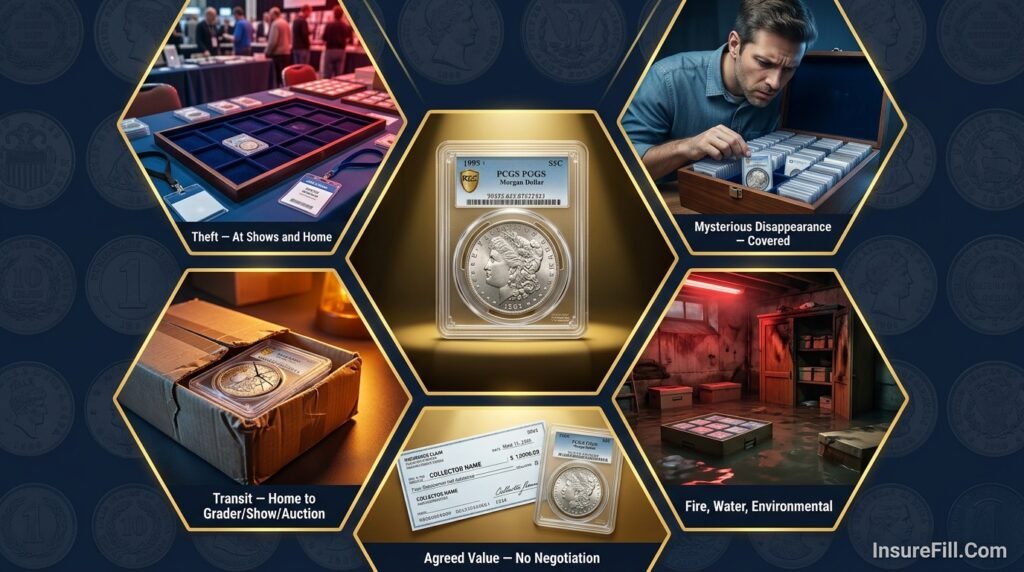
Coverage under a properly structured coin collection policy typically includes:
- Theft — at home and away from home, including at coin shows and during transport
- Mysterious disappearance — loss without a confirmed cause, which standard policies exclude
- Accidental damage — physical damage during handling or transport
- Transit coverage — while coins are being shipped to grading services, shows, or auction houses
- Fire, water, and environmental damage
- Agreed value settlement — the policy pays the scheduled amount, not a depreciated guess
The agreed value structure is the most important feature for serious collectors. Rather than an adjuster guessing what your coins are worth based on generic price guides, you and the insurer agree upfront on a documented value for each piece. At claim time, that’s what you receive.
The Role of NGC and PCGS Certification in Insurance
Third-party grading by the Professional Coin Grading Service (PCGS) and Numismatic Guaranty Company (NGC) has become the foundation of the modern numismatic insurance market. Understanding how these certifications work helps collectors understand why they’re so important for insurance purposes.
PCGS and NGC are the two premier third-party coin grading services, having authenticated and graded coins since the 1980s. Each coin submitted receives an objective numerical grade on the Sheldon Scale (1 to 70, where 70 is perfect) assigned by a consensus of experienced graders, then is sonically sealed in a tamper-evident plastic holder. As long as the coin remains in its holder, it will be valued at the assigned grade, according to APMEX’s CoinGrade guide.
For insurance purposes, certified PCGS or NGC coins offer three advantages:
Documented condition. The certification establishes the coin’s grade and condition at a specific point in time. If the coin is later damaged, the pre-loss grade is documented and undeniable.
Market reference points. PCGS and NGC maintain population reports tracking how many coins of each type have been certified at each grade. This data directly informs fair market value for insurance settlements.
Reduced claim disputes. A certified coin in a sealed holder eliminates most arguments about what the coin is. An adjuster can look up the certified grade and the documented market value without needing specialized numismatic expertise.
Some collectors believe PCGS is stricter in its grading standards, and PCGS-certified coins sometimes command 5–15% premiums over comparable NGC-certified examples in certain market segments, according to Global Coin’s June 2025 comparison. Both services are widely accepted by collectibles insurers and represent the industry standard for documentation.
NGC grading costs range from $23 to $150 per coin for standard service levels, with a $10 handling fee per submission and return shipping costs of $28 to $150 depending on declared value, per Mountain View Coin Shop’s grading cost guide. PCGS charges similar rates with slightly higher membership costs — $69 for basic membership versus NGC’s $25 Associate tier. For collections with significant individual pieces, this investment often pays for itself through cleaner insurance settlements and stronger resale liquidity.
What Insurance Costs for Coin Collections in 2026
Insurance for rare coin collections is typically priced at $0.50 to $1.50 per $100 of value annually — so for a $1 million collection, premiums may range from $5,000 to $15,000 per year, according to Bullion Shark’s June 2025 guide to insuring seven-figure collections.
For smaller collections, the range aligns more closely with general collectibles insurance rates. Scheduled personal property endorsements work well for collections valued between $5,000 and $25,000, per GR Reserve. Standalone collectibles insurance becomes more appropriate as collections grow.
| Collection Value | Estimated Annual Premium (0.5–1.5%) |
|---|---|
| $10,000 | $50 – $150 |
| $50,000 | $250 – $750 |
| $100,000 | $500 – $1,500 |
| $500,000 | $2,500 – $7,500 |
| $1,000,000 | $5,000 – $15,000 |
Several factors move your specific premium within that range:
Documentation quality. The first question any underwriter asks is how well-documented the collection is — complete inventories with grading certificates, high-resolution photographs, and provenance details command better rates than undocumented collections, according to Bullion Shark.
Storage and security. Premiums vary dramatically based on how and where coins are stored. A climate-controlled, alarmed safe bolted to the floor in a private residence may be acceptable. Some underwriters require high-value collections to be housed in bank vaults or secure depository facilities. Motion sensors, fire suppression systems, and limited-access protocols all reduce your risk profile.
Exhibition and transit exposure. Collectors who regularly attend coin shows and transport significant pieces need transit coverage and a more flexible policy than home-only collectors. Each show attendance represents an elevated risk period.
Location. Collections in areas prone to hurricanes, wildfires, or floods may trigger exclusions unless additional safeguards are in place.
Who Offers Coin Collection Insurance in 2026
Several insurers and specialty programs serve the numismatic market specifically:
Collectibles Insurance Services (CIS) — one of the most widely used specialty collectibles insurers in the U.S., offering coverage for coins, currency, and other collectibles with agreed-value settlements and worldwide protection. Their programs are familiar to most coin dealers and auction houses.
American Collectors Insurance — specializes in collectibles including coins, stamps, and sports cards. Offers agreed-value coverage with transit protection built in.
AXA XL Private Collections — AXA XL’s Private Collections Insurance explicitly covers coins alongside fine art, stamps, wine, and other collectibles. A strong option for mixed high-value collections.
Scheduled endorsement through your homeowners carrier — State Farm, Allstate, Amica, The Hartford, and Homesite all offer scheduled personal property endorsements that can list individual coins at appraised values, per MoneyGeek. This works for moderate collections but may not provide adequate claims handling expertise for large or complex numismatic collections.
For collectors who also hold fine art or other high-value personal property alongside their coins, AXA XL’s unified private collection approach and the frameworks covered in our fine art insurance guide apply directly — the same scheduling and appraisal principles govern all collectible categories.

Documentation: The Foundation of Any Claim
Regardless of which insurer you choose, your claim’s outcome depends almost entirely on the quality of your documentation. Underdocumented collections face higher premiums, more claim scrutiny, and worse settlement outcomes.
A complete numismatic collection inventory should include, for each significant piece:
- Coin identification — country, denomination, date, mint mark, variety
- Certification holder information — PCGS or NGC certification number, grade assigned
- High-resolution photographs — both obverse and reverse sides, plus the certification holder label
- Purchase records — receipts, invoices, or auction house documentation
- Current appraisal — from a certified professional reflecting current market conditions
- Provenance notes — where the coin came from, any notable prior ownership
Certified appraisers from the American Numismatic Association (ANA), Professional Numismatists Guild (PNG), or American Society of Appraisers typically charge $100 to $250 per hour or $50 to $150 for straightforward collection evaluations, per GR Reserve. Appraisals must include current market values based on recent auction results or dealer transactions — generic price guide values won’t satisfy insurance requirements.
Store complete digital copies of all documentation in cloud backup separate from your home — losing your documentation in the same event that damages your collection creates major claim complications.
Graded vs. Raw Coins: Insurance Implications
One practical question for collectors building or expanding their coverage: does it matter whether coins are certified (graded in slabs) or raw (ungraded and unencapsulated) for insurance purposes?
For insurance, certified coins are significantly easier to insure properly. The documentation is objective, the condition is locked in, and the market value is determinable with reference to population reports and recent sales data. An adjuster can evaluate a certified coin without needing deep numismatic expertise.
Raw coins present a documentation challenge. Without third-party certification, establishing a coin’s grade, and therefore its value, requires an appraiser’s subjective assessment — which insurers may dispute at claim time. For raw coins above a certain value threshold, many insurers will require an independent appraisal anyway before scheduling.
For collections with a mix of certified and raw coins, the practical recommendation is to certify through PCGS or NGC any individual piece whose value would meaningfully exceed the cost of certification. The breakeven point depends on grade expectations and the specific coin series, but for any raw coin likely worth $500 or more after certification, the investment in third-party grading typically justifies itself for insurance clarity alone.
Coin Shows and Transit: A Specific Risk Window
Coin shows represent one of the highest-risk periods in any collector’s calendar. You’re transporting significant value in a concentrated form, often in public spaces, with many strangers present.
Standard homeowners endorsements frequently limit off-premises coverage or exclude it altogether. A collector who transports $30,000 in certified coins to a regional show and experiences a theft may find their homeowners endorsement doesn’t respond — or responds only up to a low off-premises sublimit.
Dedicated collectibles policies typically include transit coverage and off-premises protection that follows the collection wherever it goes. If you regularly attend shows, confirm explicitly that your policy covers:
- Transportation to and from the venue
- Loss or theft at the show itself
- Coverage while coins are displayed at a dealer table, if applicable
- Return transit
Shipping coins to NGC or PCGS for grading represents another vulnerable window. Both grading services require submission through secured mail with appropriate declared-value insurance on the shipment. Confirm whether your collectibles policy covers coins during the grading service transit period — some do, some don’t, and this gap can be significant for high-value submissions.

Keeping Coverage Current as the Market Moves
Numismatic markets are not static. Key dates move. Registry populations shift as more coins are certified. A series that was overlooked can become fashionable. A previously overheated segment cools.
The implication for insurance is that appraisals go stale faster in the coin market than in many other collectible categories. Underwriters typically prefer recent appraisals within one to two years for collections of $500,000 or more, per Bullion Shark.
For most collections, an annual review of coverage limits against current market data is worth the time — particularly if the collection has grown through acquisitions or if specific coins have experienced notable price movements. The PCGS and NGC price guides, updated regularly and available on their respective websites, provide a reasonable first check against scheduled values.
For collectors who also manage other collectible categories alongside coins, the same coverage frameworks apply. Our sports memorabilia insurance guide covers how scheduled coverage works for high-value sports collectibles that often sit alongside numismatic collections.
Building a Coin Insurance Strategy From Scratch
Many collectors come to insurance after an incident — or after realizing their existing coverage is far below what their collection is actually worth. Starting from scratch, here’s a practical sequence that produces solid results.
Step 1 — Create a complete inventory. List every coin you own with as much detail as you have: date, mint mark, denomination, certification number if graded, estimated grade if raw, and your best estimate of current value. A spreadsheet works well. The goal is a documented baseline before you approach any insurer.
Step 2 — Separate your collection into tiers. High-value certified pieces worth $1,000 or more individually represent your most critical coverage need. Lower-value common coins can often be covered adequately under a blanket amount. Understanding this breakdown helps you focus documentation effort and avoid paying for more granular scheduling than you actually need.
Step 3 — Get a professional appraisal for your top-tier pieces. Contact an ANA or PNG member appraiser, or work with a reputable coin dealer who offers written appraisals. Make sure the appraisal specifies current retail replacement value — not wholesale, not melt value, not estate value. Insurers need replacement cost to set meaningful agreed values.
Step 4 — Contact a specialty collectibles insurer. Collectibles Insurance Services and American Collectors Insurance both offer online quote processes that are straightforward for numismatic collections. Alternatively, call your homeowners carrier and ask specifically about a scheduled personal property endorsement — and confirm whether they have staff with numismatic expertise to handle claims.
Step 5 — Compare coverage terms, not just premiums. The cheapest policy that uses actual cash value is worth far less than a slightly more expensive policy with agreed value settlement. Compare specifically on: settlement basis (agreed vs. ACV), mysterious disappearance coverage, off-premises and transit coverage, and claims handling expertise.
Step 6 — Store documentation separately from the collection. Cloud backup of all appraisal documents, certification certificates, and photographs should be accessible from anywhere — not dependent on the devices or storage at the location where the coins are kept.
The Tax Dimension: Why Proper Insurance Records Matter Beyond Claims
A point that rarely appears in coin insurance guides but is genuinely useful: the documentation you assemble for insurance purposes also supports accurate cost-basis records for tax purposes.
Collectible coins held as investments are subject to capital gains tax when sold. Long-term gains on collectibles are taxed at a maximum rate of 28% under current U.S. tax law — higher than the standard long-term capital gains rate for most assets. Accurate purchase records, appraisals showing value at specific dates, and documentation of any improvements (such as grading fees paid to establish a coin’s certified condition) all contribute to a defensible cost basis that minimizes taxable gain.
This overlap between insurance documentation and tax record-keeping means that the work of properly documenting a collection for insurance purposes has a secondary benefit. The same appraisals, receipts, and transaction records that support a clean insurance claim also support accurate tax treatment of future sales. For collectors with significant holdings, coordinating these records with a tax professional familiar with collectibles is a worthwhile annual exercise.

Frequently Asked Questions
Standard homeowners policies include personal property coverage but cap collectibles at $1,000 to $2,500 total — regardless of your collection’s actual value. They also use actual cash value calculations that don’t account for numismatic premiums, exclude mysterious disappearance, and are handled by adjusters without specialized coin knowledge. A scheduled personal property endorsement or standalone collectibles policy is necessary for any meaningful collection.
Not necessarily for every coin. Insurers can work with collector appraisals for ungraded coins. However, PCGS or NGC certification significantly simplifies both the underwriting process and any future claim settlement. For coins above a certain individual value — generally $500 or more — certification is strongly advisable before scheduling for insurance purposes.
A scheduled endorsement adds specific coin coverage to your existing homeowners policy. It works well for collections up to roughly $25,000 and leverages your existing insurer relationship. A standalone collectibles policy from a specialty insurer provides broader coverage, better claims handling by specialists, and is more appropriate for larger or more complex collections. Cost differences are often modest at similar coverage levels.
Under agreed-value policies, you and the insurer agree on a value for each scheduled piece upfront based on professional appraisal. At claim time, that’s what you receive — no negotiation, no adjuster second-guessing the market. Under actual cash value policies, the insurer’s adjuster determines value at loss time, which can produce very different outcomes for appreciating assets.
This depends entirely on your specific policy. Some collectibles policies include transit coverage that would apply. Others do not cover coins while in the grading service’s possession. Confirm this specifically with your insurer before submitting high-value coins. Both NGC and PCGS require declared-value shipping insurance on all submissions, which provides some protection for the transit itself — but policy coverage and shipping insurance serve different purposes.
Annually for significant collections with active market movements, and every one to two years as a minimum for most collections, particularly for high-value pieces. Numismatic markets can shift meaningfully in a year, and an outdated appraisal can leave you significantly underinsured for coins that have appreciated since their last professional valuation.